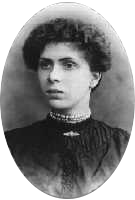
Nestor Makhno (1889-1934), Anarcho-communist activist and fighter
Makhno led an armed insurrection in Ukraine. The Makhnovist movement was one manifestation of the 1917 Russian revolution. From July 1918 to August 1921 it was a political, social, armed anarcho-communist movement: peasants and workers waged a class struggle against oppression of every sort, by the Bolsheviks and by the Whites, the forces of counter-revolution. Following the defeat of the Makhnovist movement in 1921, Makhno was dispatched into exile in western Europe. By 1925 he was living and working in Paris where he remained active in the anarchist movement to the end. He died in 1934 and his ashes were placed in an urn in the Pere Lachaise cemetery. 500 people from several nationalities attended his funeral.
Makhno told the story of the Gulyai-Polye anarchist group and events in revolutionary Ukraine: “Our agricultural commune had been both the beating economic and agricultural heart of our social system. Societies were not founded upon individual selfishness but on shared principles and local and regional solidarity. At the same time whilst every member of the community stood by his neighbour, each community was federated to the rest. Our communities were a blend of farming and industry and indeed certain of them were industrial only. Everybody fought and everybody worked. People’s assemblies handled the decision-making. As for the running of the guerrilla war, there was a war Committee made up of delegations from every single guerrilla detachment handling that. In short, everybody was part of a collective effort to prevent the emergence of a ruling class that might have monopolized power”
The name Makhno is forever associated with the revolution in south-east Ukraine.
Will they dare repatriate Makhno’s ashes to Ukraine and have them placed in the Pantheon?
“It is with a degree of misgiving that I learn of a report of a meeting of the Presidency of the Republic, bringing together the leaders of the Rada (Parliament) and the Institute for National Remembrance, in the course of which an initiative aimed at establishing a Pantheon of eminent Ukrainian personalities in Ukraine was mooted once again.
“To date, the name of Nestor Makhno featured regularly on the suggested list of 20th century fighters for independence, and since the time of Yushchenko (president of Ukraine from 23 January 2005 to 25 February 2010), we have consistently opposed any reinterment. We were against it chiefly because such a move was being pushed by the merciless foes of Makhno’s ideas and of the Ukrainian social model that the social movement that bore his name built and which the Makhnovist Army defended. Unfortunately, since then, our country has been thrust even deeper down an anti-social path in a far right direction and fetching the remains of this world famous Ukrainian anarchist back here would be tantamount to allowing his enemies to cash in on his name in order to draw a veil over their exactions targeting the people that he defended.
“I hope that French anarchists, with backing from the anarchist movement the world over, will not brook any such sacrilege. Rest in peace on foreign soil, Batko, until such time as this dictatorship forces ordinary Ukrainians to return to your ideas!”
Vyatcheslav Azarov, 28 March 2026.
From Vyatcheslav Azarov, Ukrainian historian based in Odessa; an anarchist activist specializing in Makhno and the revolutionary period in Ukraine (1917-1921). His posts can be accessed at https://t.me/last_makhnovist/1290
Taken from Courant Alternatif, (Reims) No 361. June 2026
By the way, one of V. Azarov’s recent posts was posted on 8 March:
“To mark International Women’s Day 2026, Ukraine’s official media have published articles about Ukrainian women who fought for Ukraine’s independence. Unsurprisingly, no mention was made of Galina Kuzmenko, wife of the founder of the renowned Makhnovist movement. Not only was she a teacher of Ukrainian, but she also founded “women’s councils” inside the Makhnovshchina, at which women’s rights – notably freedom to choose their own marriage partner – were debated. Unlike today’s patriots, Kuzmenko was an anarchist and was fighting for independence for Ukrainians, not for the independence of the State by which they were being oppressed. Our contemporaries struggle to make the distinction.”
Translated by: Paul Sharkey.
Subjects:
- History
- Kuzmenko, Galina (1894-1978)
- Lives (biography, autobiography)
- Makhno, Nestor (1889-1934)
- Russia / Russian Empire / Soviet Union
- Russian anarchists outside Russia
- Russian Revolution and Russian Civil War
- Ukraine
Similar items
- Archibald, Malcolm. The Many Lives of Max Chernyak.
- Archibald, Malcolm and Isaak Geraikovich Tarasiuk. The Lost Memoirs of the Anarcho-Syndicalist Isaak Tarasiuk.
- Makhno, Nestor. An Historic Injustice.
- The Ukrainian Revolution (July-December 1918) by Nestor I. Makhno [Book Review].
- KSL: Bulletin of the Kate Sharpley Library No. 66, April 2011.